
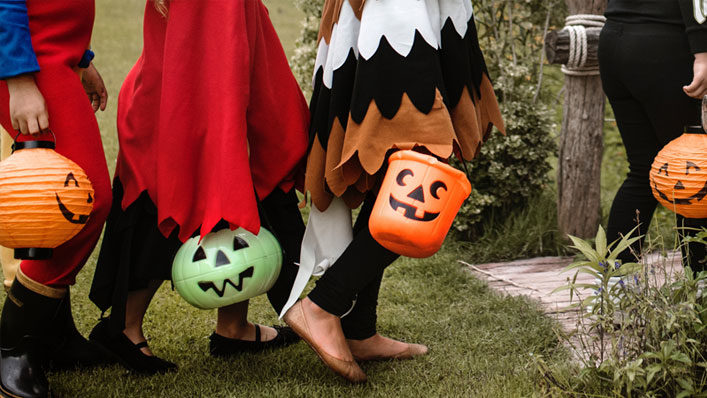
While many Americans spend October excitedly planning Halloween costumes and candies, for many Christian families the question remains: Why Christians don’t celebrate Halloween or should Christians celebrate Halloween?
As you’re making the decision to celebrate Halloween, here’s more about the holiday – how it began, what it means, and what the Bible tells us that can guide your decision.
Let’s start with exploring the history of Halloween.
History of Halloween
Halloween has its origins in the time of Samhain. This ancient three-day festival was created by the Celts of Northern Europe. Translated into modern Irish, “Samhain” means “summer’s end”. So the festival literally signals the end of summer and the beginning of a new season. Originally, Samhain came from pagan and supernatural origins, through sacrifice and offerings.

Throughout the centuries, Samhain continued in mutant form until around AD 609 when Pope Boniface IV announced a new celebration.
Originally, Pope Boniface IV created All Saints’ Day or “All-Hallows Day” to be celebrated before summer. All Saints’ Day focuses on celebrating saints and martyrs who sacrificed their lives for the Christian faith. Later, Pope Gregory III moved the celebration to the fall season to coincide with Samhain.
Over the years, All Hallows’ Day or All Saints’ Day continued to evolve into the modern-day celebration of Halloween. Samhain’s sacrifice turned into a Halloween offering of another kind: candy. However, Halloween has its roots in the pagan celebration of death and rebirth. So should Christians really celebrate Halloween? and why Christians don’t celebrate Halloween?
Why Christians don’t celebrate Halloween?
Revolving around Halloween’s fall festivities and trick-or-treating are less-than-subtle connections to questionable supernatural practices. Despite its distance from the period of its origin, Halloween is still connected with paganism. For Christians, here are 5 reasons why Christians Don’t Celebrate Halloween:
- Halloween is the devil’s holiday.
- Celebrating Halloween opens doors for demons to enter your home. It brings a 4 – 5 generation curse on your family. It is a day when witches and warlocks across the world perform spells and release curses.
- When Christians put on Halloween costumes, they open up a door for the devil to steal their God-given identities.
- Halloween is the opposite of Resurrection Sunday.
- The pumpkin at the door represents a demon and brings a curse into your home. It is a pathway for the devil to enter your home.
All things considered, this leaves Christians in a quandary. On the one hand, there are elements of Halloween that are harmless and fun. While on the other hand, Halloween contains sinister influences and promotes behaviors that present disturbing realities for families of all backgrounds. So, let’s discover a few more Halloween questions.
Questions about Halloween

What Does Halloween Mean?
Halloween is a combination of “All the Hallows” and “evening”. The word itself means “Saints” evening, and it comes from the Scottish term for All Hallow’s Eve. Over time, a variety of roots and word stems have morphed into the modern term: “Halloween”.
Is Halloween a Christian holiday?
As mentioned earlier, Halloween has direct roots with pagan and historical pagan practices. For most historians, it is unclear how long the ancient celebration remained a pagan holiday. However, the early church held annual celebrations and prayers for the deceased saints and martyrs.
Later, during the early Middle Ages, various members of the Catholic Church adopted influences from Samhain. It must be said, however, that the modern interpretation of Halloween is hardly anything related to Christianity or the Bible.
Is celebrating Halloween a sin?
For followers of Christ, our actions and conduct are judged according to our obedience to Christ. In the context of Halloween celebrations, this truth remains. We are defined by our actions and how closely our hearts align with God’s will.
Whether it’s a sin for Christians to celebrate Halloween depends on exactly how you intend to celebrate it. For some families, this may require more discretion in discussing how you plan to celebrate Halloween. For other families, these discussions may lead to a change in your plans. And that’s a perfectly acceptable response.
It is true that the Bible makes no direct mention of Halloween by name. However, the Bible carefully instructs Christians not to engage in pagan activities that directly involve the occult, witchcraft, and the worship of other deities. So, when deciding whether or not to go to Halloween, you and your family can consider how your actions might be in harmony with God.
Should Christians celebrate Halloween?
The answer: it depends.
It’s safe to say Halloween is one of the most cultural and marketable celebrations on our calendar. And according to various statistics, Halloween engagement will only continue to grow rapidly.
Thus, it is difficult for parents to say no to their children when they want to join the Halloween festival because for them the festival is fun, it is very attractive with fun games, and makeup or wear fancy and creative costumes.
The decision for children to attend or not is up to the parents and depends on the circumstances of each family, as well as the content of the activities held that day. However, the first important thing that parents need to do is teach their children the true meaning of this holiday.
Next, teach them how to live a religious life in relation to God, and teach them the difference between the culture of life and the culture of death, about the presence and activities of the devil. Teach them to stay away from acts that offend God, such as making offerings to demons, or worshiping death.
Plus, you can also ask your children to give some of the food they have received to needy children, through a charity, so that they understand that this holiday is not an opportunity for them to pamper themselves but to share with others.