

If you are a home gardener or a commercial grower, you have certainly come across the idea of hydroponics. In the previous post, we clarified “what is hydroponics” as well as the benefits of hydroponic. If you want to dig deeper into this method, keep on reading this article to learn more types of hydroponic systems.
What Are Types of Hydroponic Systems?
There are six separate types of hydroponic systems you can use, including the following:
- Wick System
- Deep Water Culture (DWC) Systems
- Ebb and Flow
- Drip
- F.T. (Nutrient Film Technology)
- Aeroponic systems
1. Wick System
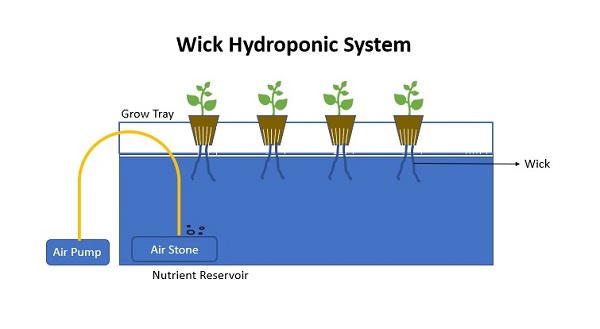
The first hydroponic system on this list is the wick system. This is also the most basic hydroelectric system you can build. It’s called passive hydroponics, which means you don’t need any air or water pumps to use it.
Plants receive nutrients and water through a wick, usually something as simple as a rope or a piece of felt. For this system to work at its best, you should use a growing media that transports water and nutrients well. Good options include coconut coir, perlite, or vermiculite.
The advantage of this system is that it’s easy to set up and is good for smaller plants that don’t use a lot of water or nutrients. Conversely, larger plants may have difficulty getting enough plants through a simple wick system.
2. Deep Water Culture (DWC) Systems
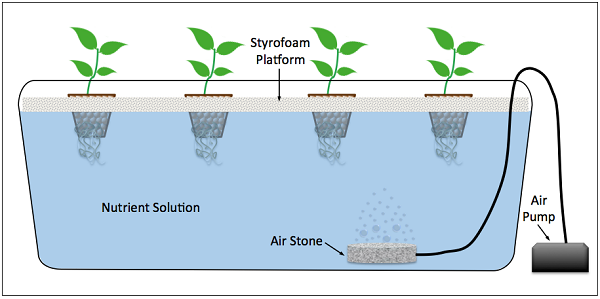
Deep water culture (DWC), is the easiest type of hydroelectric system to use. In a DWC system, you use a reservoir to store the nutrient solution. Your plant’s roots are suspended in that solution so they receive a constant supply of water, oxygen, and nutrients.
To oxygenate the water, you use an air pump with an air stone to pump air bubbles into the nutrient solution. This will keep your plant’s roots from getting submerged in the water. Plants are usually placed in mesh pots placed in foam board or on top of containers. With some hydroponic growing media added to your mesh pots, they provide a home for the start of your plant’s root and stem systems.
3. Ebb and Flow
The Ebb and Flow system, also known as the Flood and Drain, is a less commonly seen system. But they are still quite effective and maybe the best option depending on your situation.
Unlike the two previous types of hydroponic systems, an ebb and flow system doesn’t expose your plant roots to the nutrient solution on a constant basis.
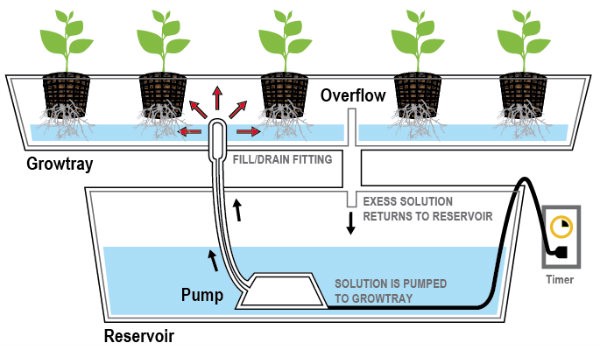
Instead, you plant in a tray filled with potting medium. The tray is “flooded” in your nutrient solution a few times per day.
After the tray is flooded, gravity draws the solution back to the reservoir, where it is being oxygenated by an air pump and air ice. It lay there waiting for the next flood cycle, and the process continued.
4. Drip Systems
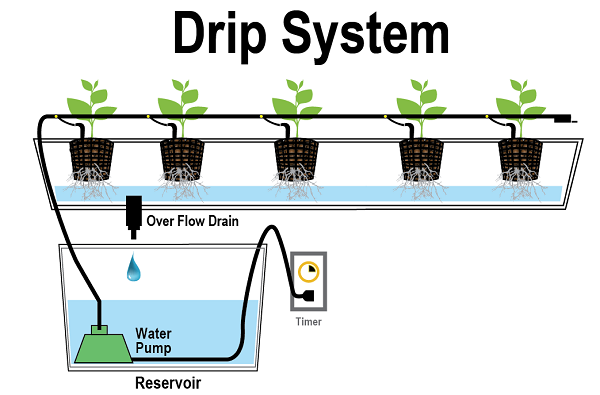
Drip systems are extremely common in commercial operations, but are less common in recreational gardens. This is because they are simple to operate on a large scale, but are a bit overkill for a smaller garden. Still, they are a great way to grow hydroponically that you should consider.
5. Nutrient Film Technique (NFT) Systems
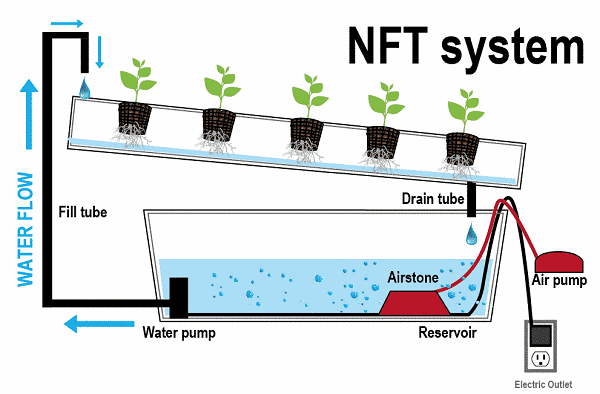
The nutrient film technique (NFT), is a popular commercial hydroponic system.
Plants are grown in channels with a nutrient solution pumped through them and continuously running along the bottom of the channel.
When the solution reaches the end of the channel, it falls back to the main reservoir and is returned to the starting point of the system again. This makes it a recirculating system, much like deep water culture.
Unlike deep water culture, your plant’s roots are not completely submerged in the NFT system. Hence the “movie” part of the system’s name.
Plants are placed in these channels using mesh pots and growing media and can be replaced or harvested one by one.
6. Aeroponics Systems
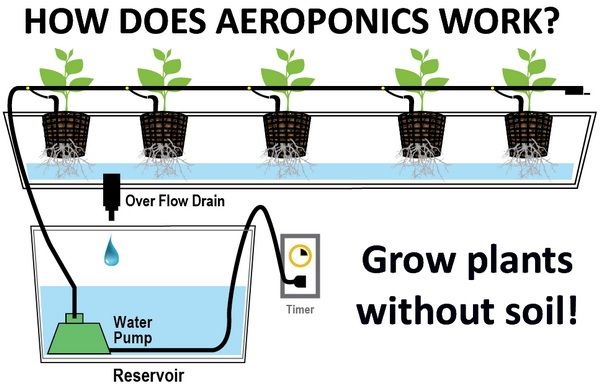
This is the most “high-tech” hydroponic setup you can build. But it is not that complicated once you understand how they work.
Aeroponic systems are similar to NFT systems in that plant roots are mostly suspended in the air. The difference is that an aeroponic system achieves this by continuously misting the root zone with the nutrient solution instead of running a thin film of the nutrient solution along the channel.
Final Words
Well, you’ve got it – 6 main types of hydroponic systems. I also explained how they work and the ups and downs of each. Regardless of which one you pick, your plants will grow well as long as you take care of them properly.
If you are considering entering the world of commercial hydroponics, Trimleaf could be the perfect solution for you. Trimleaf works directly with the most trusted names in the industry to make it easier and more modern for you to buy equipment.